

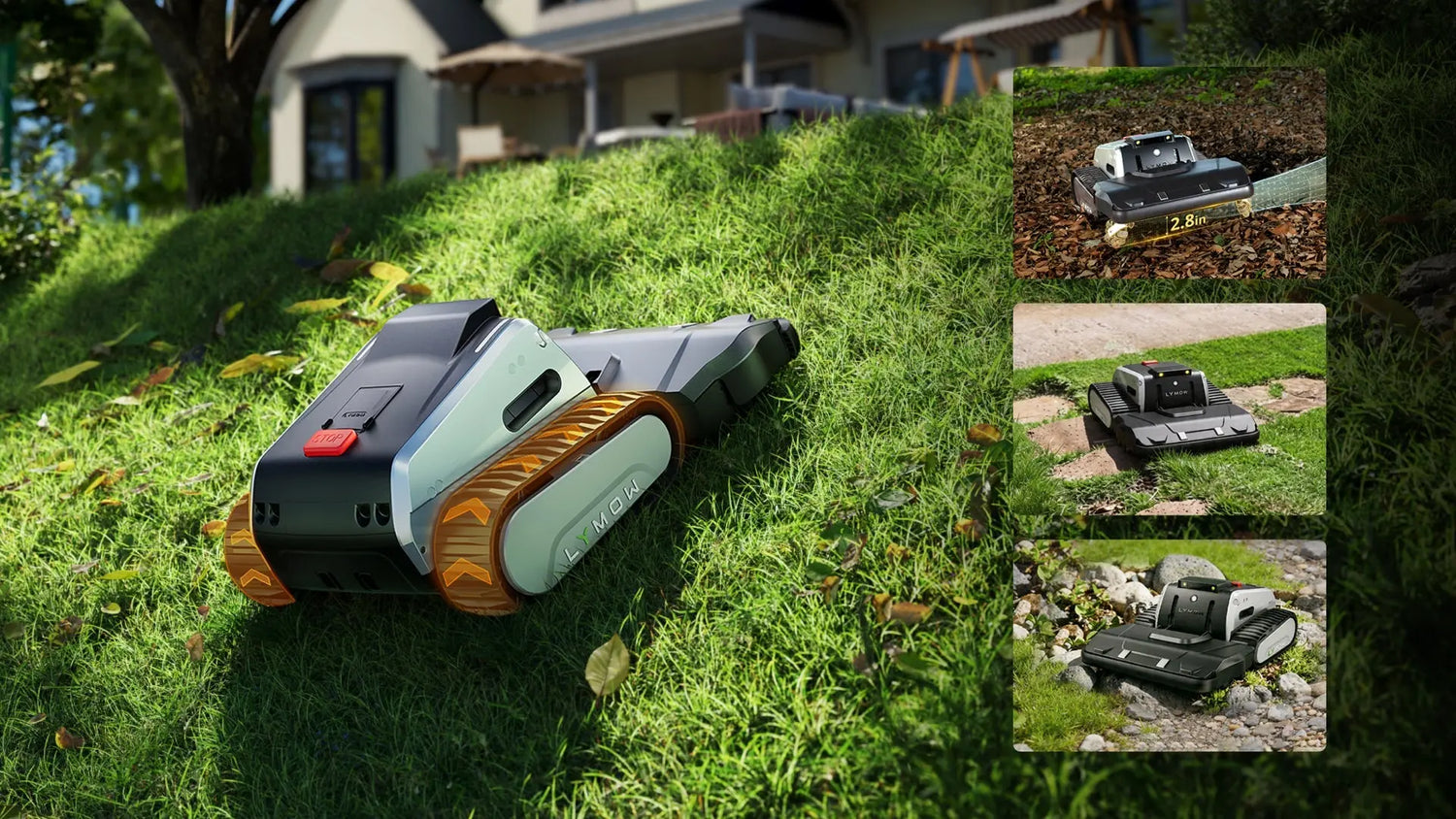
Sloped yards present unique safety challenges for robot mowers. Choosing the wrong model risks tipping, blade injuries, or equipment damage on steep terrain. The most critical safety features for sloped yards include tilt sensors that immediately stop blades when the mower tilts beyond safe angles, lift detection systems, cliff detection sensors, and robust traction systems.
Finding the best robot lawn mower for hills means looking beyond basic specifications. Modern robotic slope mower models like the Lymow One Plus now combine AI-powered obstacle avoidance with tracked treads capable of handling 100% (45°) slopes, setting new standards for safe automated mowing on challenging terrain. Understanding these seven essential safety features helps homeowners in hilly regions select a slope mower that protects family, pets, and property while maintaining effective lawn care.
Understanding Slope Ratings for Your Yard
Before diving into the features, it's crucial to understand how manufacturers rate a robot lawn mower for hills. Slope capability is expressed in either degrees or percentages: a 45° slope equals a 100% grade, while 30° equals approximately 57.7%.
Most entry-level robot mowers handle 20-25% slopes (11-14°), while mid-range models manage 30-40%. However, the Lymow One Plus stands out with its certification for 45° (100%) slopes in automatic mode, verified through CE certification at TÜV Rheinland with slope trials exceeding 30°. For extreme spot treatments, its manual operation handles up to 50° slopes.
7 Essential Features for the Best Robot Mower for Hills
If your yard has sections measuring 35% or higher, prioritize these seven safety systems to find the perfect lawn mower for steep slopes.
1. Tracked Traction Systems vs. Wheels
Traction technology directly impacts safety on slopes; inadequate grip leads to sliding and loss of control. While premium wheeled models use All-Wheel Drive (AWD) for slopes up to 30%, a true heavy-duty slope mower requires tracks.
The Lymow One Plus employs tracked treads that provide continuous ground contact across the entire footprint, distributing weight more evenly than wheels. This prevents the unit from digging in or slipping on wet, thick grass. Furthermore, this tracked system confidently handles vertical obstacles up to 7cm.
2. Tilt and Lift Detection (Immediate Blade Shutdown)
Tilt sensors prevent the most dangerous accidents: blade contact during tipping. These sensors use IMU (Inertial Measurement Unit) technology to monitor orientation. When a mower tilts beyond its safe operating angle (typically 30-35°), the system immediately disengages blade power and stops forward motion.
Lift detection works in tandem; if someone picks up the mower, sensors trigger an instant shutdown. The Lymow One Plus integrates both tilt and lift detection as standard, meeting international safety standards and providing peace of mind for households with children or pets.
3. AI-Powered Obstacle and Cliff Detection
A robot mower hills scenario requires advanced environmental awareness to prevent catastrophic falls from terraces or retaining walls. Cliff detection stops and reverses the mower before it reaches a dangerous drop-off.
The Lymow One Plus employs a comprehensive sensor suite including five ultrasonic sensors and binocular VSLAM stereo cameras for 3D understanding. This AI vision system is trained to recognize trees, lawn furniture, and pets, reducing the risk of collisions that could cause the mower to flip on a slope. Additionally, its front bumper features upgraded Hall magnetic switches for higher sensitivity.
4. Emergency Stop and Manual Override Controls
When managing a remote control mower for slopes, operators should supervise steep terrain from level ground. Remote emergency stop capabilities via physical buttons or smartphone apps are non-negotiable.
The Lymow One Plus supports Bluetooth (20-50m range), 2.4GHz WiFi, and 4G LTE, enabling remote monitoring from anywhere. It also provides a manual override mode for challenging conditions.
5. Weather Resistance and Rain Sensors
Operating on slopes in wet conditions multiplies safety risks due to reduced traction. Quality mowers feature IPX5 or IPX6 waterproof ratings. The Lymow One Plus carries an IPX6 rating and includes heated camera lenses to prevent fogging in humid conditions, ensuring the vision system remains effective.
Intelligent rain sensors detect precipitation and automatically return the mower to its charging station, preventing the machine from slipping on wet grass.
6. Low Center of Gravity and Stability Design
A low center of gravity reduces tipping risk by keeping weight close to the ground. The Lymow One Plus measures exactly 29.5 × 23.6 × 12.6 inches (750 x 600 × 320 mm) and weighs 78.5 lbs ±1 lb, balancing heavy-duty stability with agile maneuverability. Its tracked design distributes this weight across a larger contact patch than wheeled models, significantly reducing ground pressure and improving stability during sharp directional changes on steep hills.
7. Strategic Zone Setup and Safe Docking
Mowing pattern selection and charging station placement heavily affect slope safety. The station must sit on level ground with at least 1-1.5 meters of flat approach area. Placing a station at the top or bottom of a steep hill creates docking risks.
The Lymow One Plus supports mapping up to 80 zones across a total area of 15 acres (60,000m²), allowing flexible zone definition. Homeowners can customize mowing patterns via the app, using side-to-side (perpendicular) patterns on steep sections to maximize traction.
Comparison: Slope-Capable Robot Mower Safety Features
| Feature | Entry-Level (20-25% slope) | Mid-Range (30-40% slope) | Lymow One Plus (45° / 100% slope) | Premium Wheeled AWD (35-45% slope) |
| Traction System | 2WD wheels | AWD wheels | Heavy-duty tracked treads | AWD with aggressive tread |
| Tilt/Lift Sensors | Basic accelerometer | IMU with <0.5s response | IMU with lift detection | Advanced IMU |
| Obstacle Detection | Bumper only | Ultrasonic (3-5 sensors) | 5 ultrasonic + AI vision (VSLAM) | Ultrasonic + basic vision |
| Cliff Detection | Limited or none | Downward ultrasonic | Binocular stereo cameras + ultrasonic | Infrared or ultrasonic |
| Obstacle Clearance | 3-4cm | 5cm | 7cm (2.8 inches) | 5-6cm |
| Waterproof Rating | IPX4 | IPX5 | IPX6 | IPX5-IPX6 |
| Emergency Stop | Physical button only | Button + WiFi app | Button + Bluetooth/WiFi/4G app | Button + WiFi app |
| Slope Certification | Manufacturer claim | Independent testing | CE certified (TÜV Rheinland 30°+) | Varies by brand |
| Best For | Gentle rolling lawns | Moderate hills, terraced yards | Extreme slopes, complex terrain | Steep hills with smooth surfaces |
Frequently Asked Questions
Q: What slope percentage is safe for the best mower for hills and rough terrain?
A:Most standard mowers safely handle 20-25% slopes. For rough, steep terrain, specialized models like the Lymow One Plus are certified for 45° (100%) slopes. Always measure your yard’s steepest section before purchasing.
Q: Do I need AWD or tracks for a 30% slope?
A:AWD wheels provide adequate traction for 30% slopes in dry conditions, but tracks become essential for slopes exceeding 35-40% or properties with frequent rain. The Lymow One Plus’s tracked design excels on steep, wet terrain where wheels often slip.
Q: Can robot mowers handle wet slopes safely?
A:Quality models with IPX6 waterproofing and rain sensors can operate on wet slopes, though traction is reduced. The Lymow One Plus features IPX6 weather sealing and heated camera lenses. However, it is always recommended to avoid operation during heavy rain when traction is compromised.


Leave a comment
This site is protected by hCaptcha and the hCaptcha Privacy Policy and Terms of Service apply.