


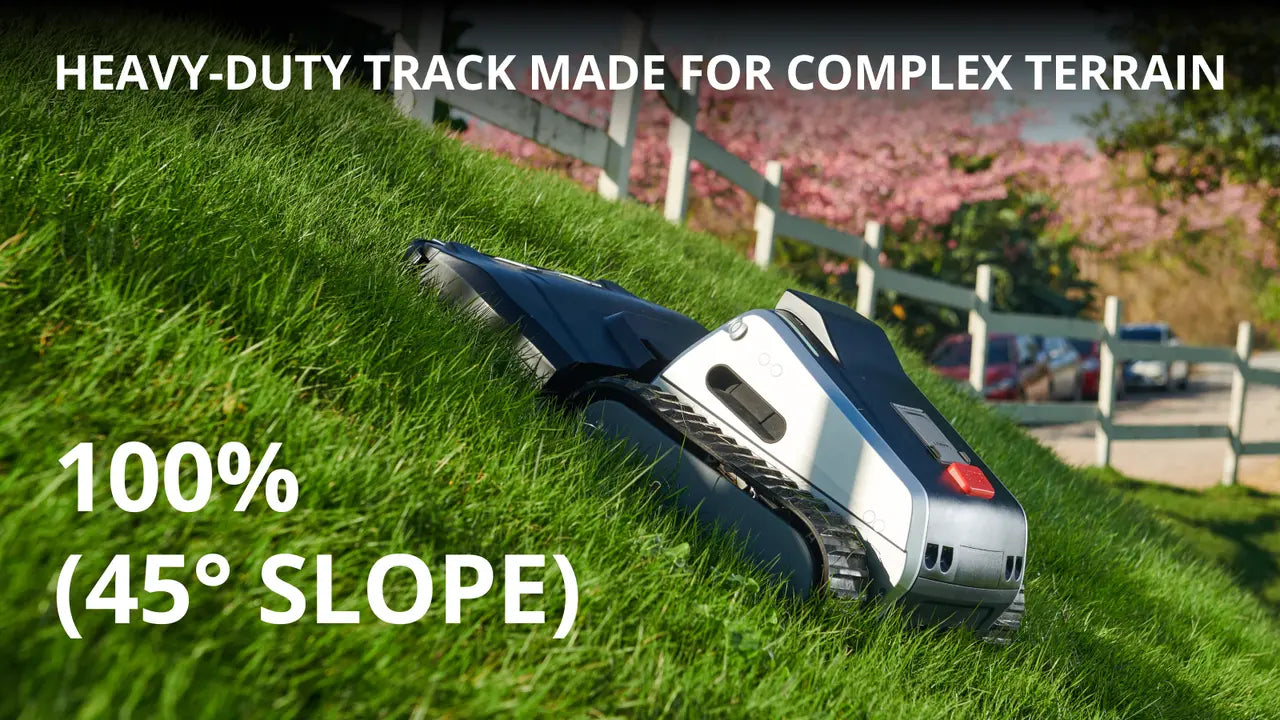
Robot mowers may damage steep lawns when used beyond their rated slope capacity, but high-end models like the Lymow One Plus are engineered to avoid harm. The core factors are slope rating, traction system, and operating conditions. Most damage comes from wheel slippage that tears turf, creates ruts, and leaves bare patches. Choosing a mower rated 5–10° higher than your steepest section and avoiding wet grass mowing prevents nearly all slope-related lawn damage.
Understanding Slope Measurements for Safe Robot Mowing
Slope percentage and degree directly decide whether a robot mower can work safely on your lawn. A 25% slope equals 14°, 35% equals 19.3°, and 45° equals a 100% grade. You can measure your lawn gradient using the rise-over-run formula: divide the vertical height change by horizontal distance, then multiply by 100 for a percentage.
Most residential lawns have gentle slopes below 15%, moderate slopes of 20–30%, and steep areas of 35–45%. Accurate measurement helps you avoid buying an underpowered mower that slips and damages grass.
Common Slope Conversion Table
| Percentage Grade | Degree Angle | Typical Application |
| 15% | 8.5° | Gentle residential slope |
| 25% | 14° | Moderate hill |
| 35% | 19.3° | Steep residential terrain |
| 45% | 24° | Very steep property edge |
| 70% | 35° | Extreme hillside |
| 100% | 45° | Maximum rated capability |
How Robot Mowers Damage Steep Lawns
Robot mowers harm steep lawns in four typical ways, all avoidable with the right machine and setup.
1. Wheel Slippage
Slipping wheels on wet grass or over‑rated slopes spin and tear grass roots, causing ruts and bare spots. Traction drops by 40–60% in wet conditions, making this the most common damage type.
2. Scalping at Slope Transitions
Rigid cutting decks suddenly change angle between flat and sloped ground, cutting too low and exposing soil. Floating decks maintain consistent height to prevent scalping.
3. Rutting in Soft Soil
Heavier wheeled mowers sink into wet or clay soil, leaving permanent tracks. Tracked systems spread weight evenly to lower compression and rutting.
4. Boundary Overrun
Mowers can lose control on steep descents and slide past boundaries. Models with gyroscopic and slope sensors slow down or stop automatically to avoid this.
Slope Capability by Robot Mower Type
Different mower types handle slopes differently, with clear risk differences.
| Mower Type | Max Slope | Traction | Wet Grass | Damage Risk |
| Entry‑Level 2WD | 20–25% (11–14°) | Basic wheels | Poor | High on steep areas |
| Mid‑Range | 30–35% (17–19°) | Improved tread | Moderate | Medium over rating |
| Premium AWD | 70–80% (35–38°) | 4WD wheels | Good | Low within rating |
| Lymow One Plus | 100% (45°) | Tracked treads | Excellent | Low with proper setup |
Entry‑level mowers work only on gentle slopes. Premium tracked or AWD models are designed for steep and complex terrain.
Key Features to Prevent Lawn Damage on Slopes
The right features eliminate most slope‑related damage effectively.
- Tracked Traction: Full‑contact grip distributes weight and stops slippage on 45° slopes.
- High‑Torque Brushless Motors: Stable power prevents stalling and repeated passes.
- Floating Cutting Deck: Maintains 1.2–4 inch cutting height across terrain changes.
- Advanced Sensors: AI vision, ultrasonic, and hall detection stop blades and movement in dangerous situations.
- Rain Sensors: Pause mowing in wet conditions to preserve traction.
- RTK‑VSLAM Navigation: Centimeter‑level precision avoids drift and boundary errors.
The Lymow One Plus integrates all these features to protect steep lawns in wet, rough, or uneven conditions.
Best Robot Mowers for Steep Lawns in 2026
Extreme Slopes (35–45° / 100% Grade)
Lymow One Plus is built for challenging terrain. It supports 45° slope capability, 1785W motor, 528Wh battery, 16'' cutting width, and IPX6 waterproofing. It works well for large properties with wet ground, roots, or gravel.
Very Steep Terrain (30–35°)
Mid‑range AWD mowers suit small suburban yards in dry conditions, but perform poorly on wet soil.
Gentle Slopes (Under 25°)
Entry 2WD mowers work for flat lawns. Always choose a model rated 5–10° above your steepest area for safety.
Setup & Maintenance Tips for Steep Lawns
Installation Tips
- Place the charging station on level ground near a power outlet.
- Set 3–5 foot buffer zones before steep drops or edges.
- Map your lawn only in dry conditions with 2–4 inch grass.
- Test steep zones manually before autonomous use.
Maintenance Tips
- Never mow wet grass on slopes.
- Inspect tracks or tires monthly and clean debris after each use.
- Keep blades sharp every 4–6 weeks.
- Adjust cutting height seasonally: 3–4 inches in spring, 2–3 inches in fall.
Tracked vs. Wheeled Mowers on Slopes
| Feature | Tracked (Lymow One Plus) | AWD Wheeled | 2WD Wheeled |
| Max Safe Slope | 100% (45°) | 70–80% | 20–25% |
| Wet Grass Traction | Excellent | Good | Poor |
| Weight Distribution | Even | Wheel‑concentrated | High pressure points |
| Rutting Risk | Low | Medium | High |
| Obstacle Clearance | 2.8 inches | 1.5–2 inches | 1–1.5 inches |
| Best For | Rough, wet, steep slopes | Moderate dry hills | Flat, smooth lawns |
FAQ
Q: Can robot mowers handle slopes safely in wet conditions?
A: Advanced tracked models like Lymow One Plus maintain traction on wet grass up to 45° slopes through continuous ground contact. Wheeled mowers should avoid wet-slope operation above 20% grades, as moisture reduces tire grip by 40-60%, causing turf-damaging slippage. Rain sensors in premium models automatically pause operation during precipitation.
Q: What slope rating should I choose for a lawn with 30% grades?
A: Select a mower rated at least 35-40% (5-10° above your steepest section) to provide a safety margin during wet conditions or thick grass. Lymow One Plus’s 100% rating offers substantial overhead for 30% properties, preventing damage from unexpected slippage. Operating near maximum rating increases turf damage risk significantly.
Q: How do I prevent scalping on slope transitions?
A: Choose mowers with floating cutting decks that maintain consistent height across terrain changes. Lymow One Plus’s adjustable 1.2-4 inch (30-100mm) cutting height adapts to slope transitions automatically, preventing the blade-to-soil contact that causes scalping. Avoid fixed-deck entry-level models on properties with frequent elevation changes.
Q: Will a heavy robot mower damage my lawn on hills?
A: Weight distribution matters more than total mass. Lymow One Plus’s tracked system spreads its net weight of 35.6kg/78.5 lbs ±1 lb across a large footprint, reducing ground pressure below wheeled mowers that concentrate weight at tire contact patches. This prevents rutting even on soft clay soil during humid conditions common in Southern states.
Choose the Right Mower for Your Steep Lawn
Robot mowers do not have to damage your steep lawn. The solution is simple: measure your slope accurately, choose a mower rated 5–10° higher, prioritize tracked or AWD traction, and avoid mowing wet grass.
Ready to maintain your hillside property without turf damage? Explore Lymow One Plus’s tracked traction system and 45° slope capability at lymow.com to find the solution for challenging terrain. Proper equipment selection today prevents costly lawn restoration tomorrow.

Leave a comment
This site is protected by hCaptcha and the hCaptcha Privacy Policy and Terms of Service apply.